12-28 Tap Drill Size
Unified fine (UNF) · 28 threads per inch · ASME B1.1, class 2B
What size drill bit for a 12-28 tap?
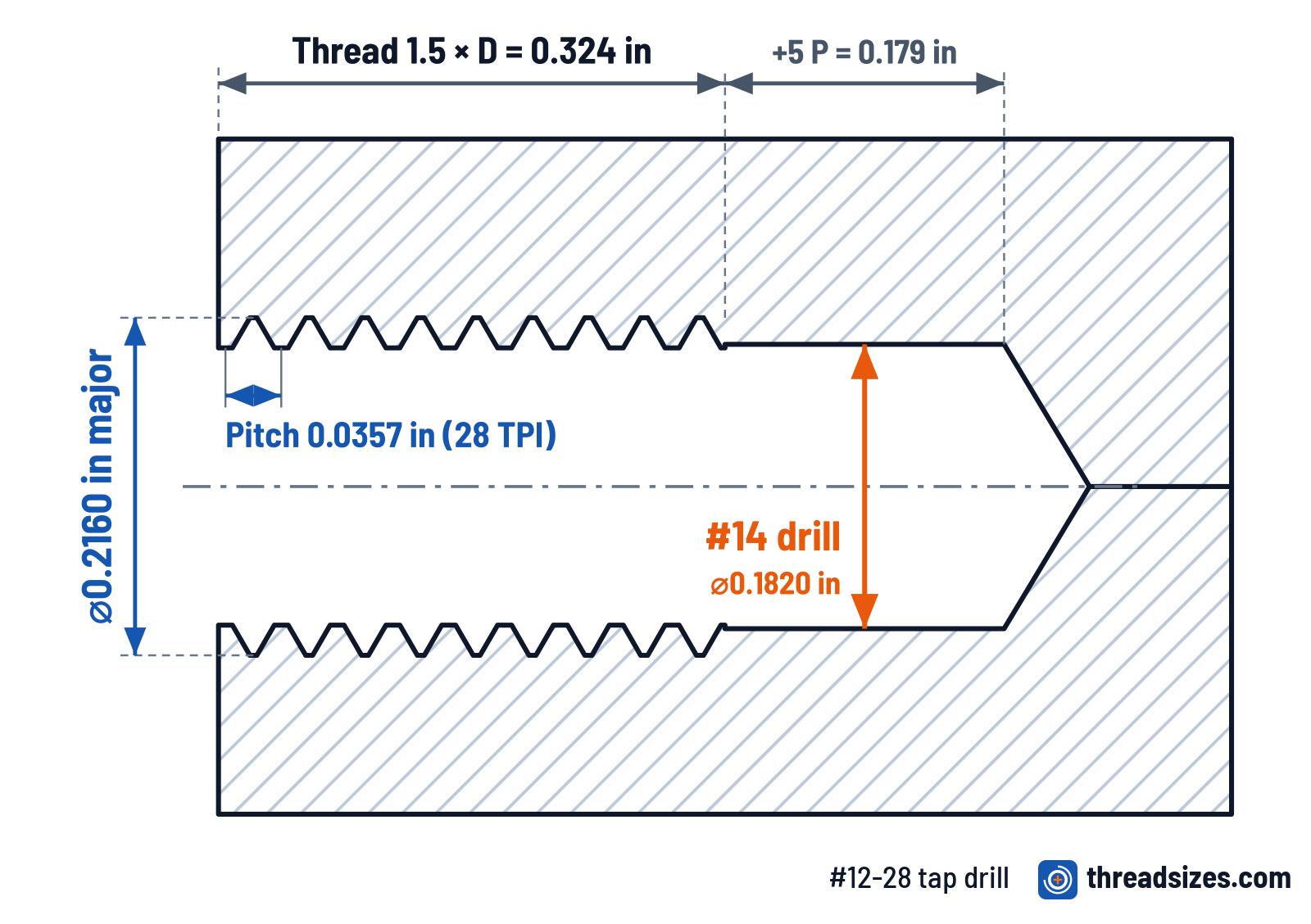
To scale section of the tapped hole
Drawing callout same hole, as a plan note
⌀.182 ↧.50 / 12-28 UNF-2B ↧.32
Thread depth 1.5 × D, drilled 5 pitches deeper for a plug tap; change both to suit your part. Through hole for a screw instead? Use the clearance hole: ⌀.228 free fit (older ASME two-fit chart, clearance hole chart). How to read this →
Drill options % of thread
| Drill | Inch | mm | Thread | 2B |
|---|---|---|---|---|
| #16 | 0.1770 | 4.50 | ✗ | |
| 4.5 mm | 0.1772 | 4.50 | ✗ | |
| #15 | 0.1800 | 4.57 | ✓ | |
| 4.6 mm | 0.1811 | 4.60 | ✓ | |
| #14Use | 0.1820 | 4.62 | ✓ | |
| #13 | 0.1850 | 4.70 | ✓ | |
| 4.7 mm | 0.1850 | 4.70 | ✓ | |
| 3/16" | 0.1875 | 4.76 | ✗ | |
| #12 | 0.1890 | 4.80 | ✗ |
By material Aluminum, brass, mild steel: #14 (73%) · Stainless, tool steel: #13 (67%)
75% (orange tick) is the usual target. Hard or gummy metals like stainless are often tapped at 60 to 65% to spare the tap; aluminum, brass and plastic take 75% or a little more. The last column checks the hole against the 2B minor diameter limits (0.177 in to 0.186 in).
12-28 UNF ASME B1.1, class 2B
| Major diameter | 0.2160 in / 5.49 mm |
|---|---|
| Threads per inch | 28 TPI (pitch 0.0357 in) |
| Pitch diameter 2B | 0.1928–0.1969 in |
| Minor diameter 2B | 0.1773–0.1858 in |
| Thread depth (basic, 5/8 H) | 0.0193 in |
| Forming tap drill (estimate) | 55% 13/64" 0.2026 in65% #7 0.2002 in75% #8 0.1978 in |
Forming tap drills are estimates from the rule tap makers use (D − 0.0068 × % × pitch, in inches), shown at 55, 65 and 75% thread with the nearest drill; 65% is the usual starting point. Confirm with your tap maker's chart. Forming taps push the metal instead of cutting it, so never use this drill with a cutting tap.
Clearance hole older ASME two-fit chart
ASME B18.2.8-1999 Table 1 lists only preferred sizes and omits #12-28, so this size has no close / normal / loose fit in the current standard. The two drills above are from the older ASME two-fit convention, still reproduced in published charts; the Free value is what shops typically use when a modern “normal” fit is wanted. All sizes: clearance hole chart.
Cross-checks published tables that agree
| Tap drill #14 | 5 of 7 |
|---|---|
| Pitch diameter 2B | 2 of 2 |
Tables that list the same value, out of those that list one; a reprint of another table counts once. The others list #15 for the tap drill. How values are checked.
Hole depth rule of thumb
- 0.216 inthread engagement to start from in steel (1 × D); the right figure depends on the materials, the thread class and the load
- 0.324 inin cast iron or brass (1.5 × D), up to 0.432 in in aluminum
- +0.179 inextra drill depth below the thread for a plug tap (5 pitches), +0.071 in with a bottoming tap
Full table and the ASME B1.1 formula: thread engagement chart.
Questions
What size is a #14 drill bit?
A #14 drill is 0.1820 in (4.62 mm), between 11/64 (0.1719 in) and 3/16 (0.1875 in). It is the standard tap drill for #12-28.
Tapped #12-28?