UNC vs UNF: coarse vs fine thread
Updated October 11, 2026
UNC and UNF are the two everyday thread series for inch screws and bolts. UNC is coarse, UNF is fine, and the only difference between a pair is how many threads fit in an inch: a 1/4-20 and a 1/4-28 are both 1/4 in across, but the first has 20 threads per inch and the second has 28. They do not mix. A 1/4-28 screw will not go into a 1/4-20 hole beyond the first thread or so.
What the letters stand for
UN marks the Unified thread, the inch thread standard used in the US and Canada and written up in ASME B1.1. People often expand it to "Unified National", a holdover from the older American National series it replaced. The last letter is the series: C for coarse, F for fine. So 3/8-16 UNC-2A reads as: 3/8 in diameter, 16 threads per inch, Unified coarse, class 2A (the normal fit for a screw; 2B is the matching hole).
There is also a third series, UNEF (extra fine), used mostly on thin tubing and some instrument parts. You will rarely meet it on a hardware-store bolt.
Same diameter, different thread count
Every size from #1 to 1-1/2 in has both a coarse and a fine thread. Because the threads are spaced differently, each one needs its own tap and its own tap drill: the fine thread is shallower, so its tap drill is the same or a little larger. Each linked thread has a page with drill options and percent of thread.
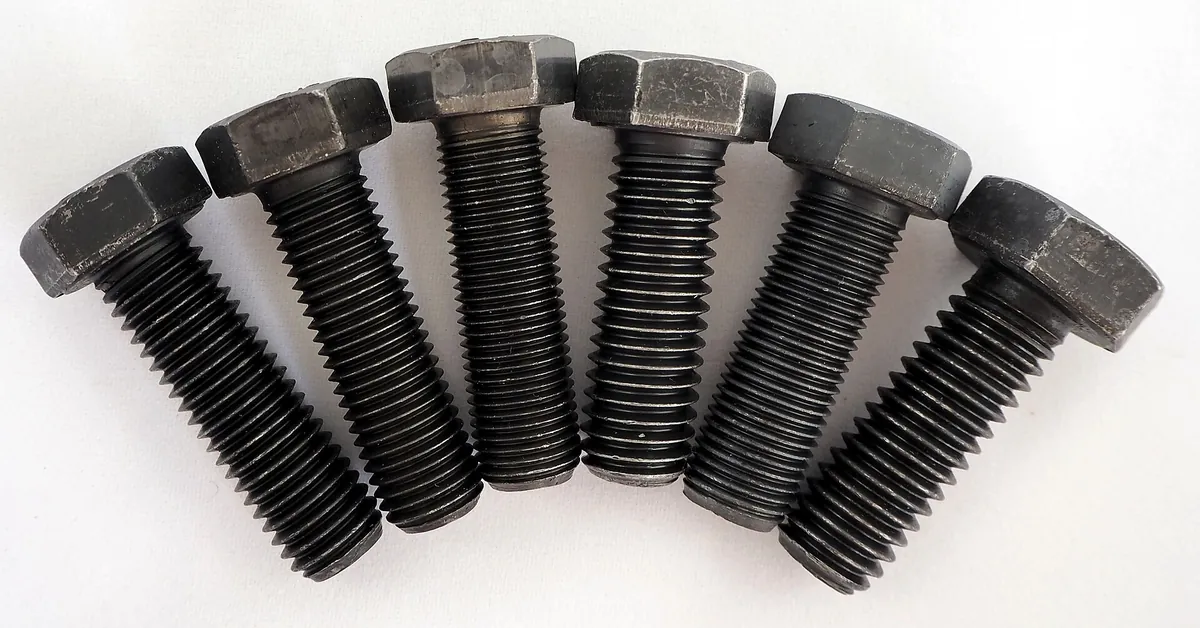

| Size | Coarse (UNC) | Fine (UNF) | UNC tap drill | UNF tap drill | Thread depth, UNC / UNF |
|---|---|---|---|---|---|
| #1 | #1-64 | #1-72 | #53 | #53 | 0.0085 / 0.0075 in |
| #2 | #2-56 | #2-64 | #50 | #50 | 0.0097 / 0.0085 in |
| #3 | #3-48 | #3-56 | #47 | #45 | 0.0113 / 0.0097 in |
| #4 | #4-40 | #4-48 | #43 | #42 | 0.0135 / 0.0113 in |
| #5 | #5-40 | #5-44 | #38 | #37 | 0.0135 / 0.0123 in |
| #6 | #6-32 | #6-40 | #36 | #33 | 0.0169 / 0.0135 in |
| #8 | #8-32 | #8-36 | #29 | #29 | 0.0169 / 0.0150 in |
| #10 | #10-24 | #10-32 | #25 | #21 | 0.0226 / 0.0169 in |
| #12 | #12-24 | #12-28 | #16 | #14 | 0.0226 / 0.0193 in |
| 1/4 in | 1/4-20 | 1/4-28 | #7 | #3 | 0.0271 / 0.0193 in |
| 5/16 in | 5/16-18 | 5/16-24 | F | I | 0.0301 / 0.0226 in |
| 3/8 in | 3/8-16 | 3/8-24 | 5/16" | Q | 0.0338 / 0.0226 in |
| 7/16 in | 7/16-14 | 7/16-20 | U | 25/64" | 0.0387 / 0.0271 in |
| 1/2 in | 1/2-13 | 1/2-20 | 27/64" | 29/64" | 0.0416 / 0.0271 in |
| 9/16 in | 9/16-12 | 9/16-18 | 31/64" | 33/64" | 0.0451 / 0.0301 in |
| 5/8 in | 5/8-11 | 5/8-18 | 17/32" | 37/64" | 0.0492 / 0.0301 in |
| 3/4 in | 3/4-10 | 3/4-16 | 21/32" | 11/16" | 0.0541 / 0.0338 in |
| 7/8 in | 7/8-9 | 7/8-14 | 49/64" | 13/16" | 0.0601 / 0.0387 in |
| 1 in | 1-8 | 1-12 | 7/8" | 59/64" | 0.0677 / 0.0451 in |
| 1-1/8 in | 1-1/8-7 | 1-1/8-12 | 63/64" | 1-3/64" | 0.0773 / 0.0451 in |
| 1-1/4 in | 1-1/4-7 | 1-1/4-12 | 1-7/64" | 1-11/64" | 0.0773 / 0.0451 in |
| 1-3/8 in | 1-3/8-6 | 1-3/8-12 | 1-7/32" | 1-19/64" | 0.0902 / 0.0451 in |
| 1-1/2 in | 1-1/2-6 | 1-1/2-12 | 1-11/32" | 1-27/64" | 0.0902 / 0.0451 in |
Thread depth here is the basic depth of the thread in the tapped hole. It shrinks as the pitch gets finer, which is the whole story behind most of the differences below.
How to tell coarse from fine
Start with the diameter. Calipers across the crests give the size (it reads a little under nominal; pick the nearest size in the table). Then check the thread count:
- Pitch gauge. Try leaves until one sits in the threads with no light under it. The number on that leaf is the TPI.
- Count over a known length. Lay a ruler along the screw and count crests over 1/2 in, then double it. A 1/4-20 shows 10 threads in 1/2 in, a 1/4-28 shows 14.
- Test against a known nut. A nut that spins on by hand for several turns matches; one that stops after a turn does not.
The thread count alone is not enough to name a screw. 32 TPI is the coarse thread of #8-32 and the fine thread of #10-32; 20 TPI is coarse on a 1/4 in screw and fine on a 1/2 in one. Measure both numbers. If you are not sure whether a screw is inch at all, see SAE vs metric and the thread identification guide.
When coarse is the usual choice
Coarse is the default for general hardware: it is the thread you are most likely to find on a bolt, nut or cap screw off the shelf. It suits general work for a few reasons:
- It starts more easily and is less fussy about cross-threading, since each thread is bigger.
- The deeper thread gives more bite in softer materials such as aluminum, cast iron and plastics, where fine threads in the hole strip sooner.
- It tolerates dings, paint and dirt better, and assembles faster: fewer turns per inch.
When fine earns its place
Fine threads show up where the shallower thread or the smaller pitch does a job:
- Thin walls and tubing. A shallow thread cuts less material away, so there is more wall left.
- Fine adjustment. Each turn moves the screw less (3/8-24 advances 1/24 in per turn against 1/16 in for 3/8-16), useful on adjusters and stops.
- A little more tensile strength for the same diameter. Because less metal is cut away, the fine thread has a larger tensile stress area, the cross-section that carries the load in tension. For the same grade of steel, the bolt carries proportionally more load before it yields.
| Coarse | Fine | Stress area, sq in | Fine has |
|---|---|---|---|
| #10-24 | #10-32 | 0.0175 vs 0.0200 | +14% |
| 1/4-20 | 1/4-28 | 0.0318 vs 0.0364 | +14% |
| 3/8-16 | 3/8-24 | 0.0775 vs 0.0878 | +13% |
| 1/2-13 | 1/2-20 | 0.1419 vs 0.1599 | +13% |
| 5/8-11 | 5/8-18 | 0.226 vs 0.256 | +13% |
That gain is real but modest, and it belongs to the bolt. Whether the joint as a whole is stronger depends on what the screw threads into: in steel nuts and tapped steel, fine threads do well; in soft metals the coarse thread in the hole is often the safer bet. For critical joints, follow the design or an engineer, not a rule of thumb.
Tapping either one
The process is the same for both; only the drill changes. Use the tap drill for the exact thread, not just the diameter, and check the inch tap drill chart if you need every size at once. Step-by-step instructions are in how to tap a hole, and the screw sizes guide explains how inch sizes are written.