SAE vs metric: how to tell bolts and tools apart
Updated October 11, 2026
In a garage or a hardware aisle, "SAE" just means inch: inch bolts, inch nuts, and the wrenches and sockets that fit them. Metric means sizes in millimeters. The two look almost identical in the drawer, and a few sizes are so close that the wrong bolt will start in the hole before it jams. Here is how to tell them apart with what is on the bench, and why the near misses do not swap.
What "SAE" actually refers to
SAE is the Society of Automotive Engineers. Its standard SAE J429 sets the strength grades for inch bolts, which is where the name stuck. The thread itself is the Unified inch thread, coarse (UNC) or fine (UNF): see UNC vs UNF. "Standard" sockets in a tool catalog are the same thing: inch sizes. So an "SAE bolt" is a Unified inch bolt, and an "SAE socket" is an inch socket.
Check 1: the head
On hex bolts, the head often answers the question before you pick up a tool. Inch bolts graded to SAE J429 carry radial lines: none for grade 2, three for grade 5, six for grade 8. Metric bolts carry their property class as a number, such as 8.8, 10.9 or 12.9, stamped on top or on the side of the head.
The check has limits. A head with no marks at all could be inch grade 2 or an unmarked bolt of either kind, and small machine screws often carry no mark at all. Treat the head as a strong hint, then confirm with a measurement.
Check 2: which wrench fits
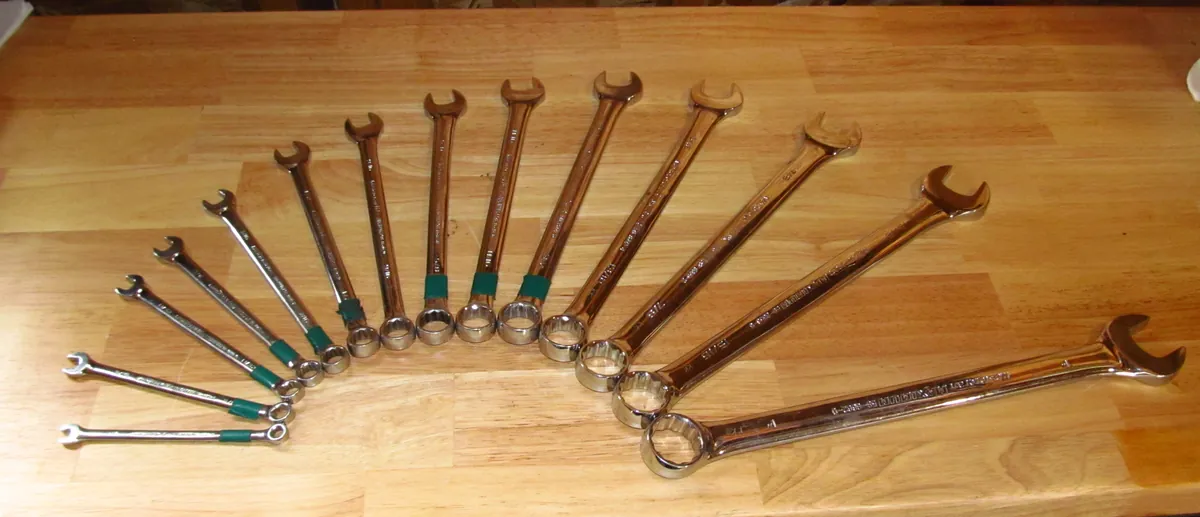
A wrench that slides on with no play is a good sign. Inch hex bolts take inch wrenches; metric bolts take metric ones. The list below puts both in one ladder, smallest to largest, so you can see where they crowd together.
| Wrench | In mm | Fits a hex bolt of |
|---|---|---|
| 8 mm | 8 | M5 |
| 10 mm | 10 | M6 |
| 7/16 in | 11.11 | 1/4 in |
| 1/2 in | 12.70 | 5/16 in |
| 13 mm | 13 | M8 |
| 9/16 in | 14.29 | 3/8 in |
| 5/8 in | 15.88 | 7/16 in |
| 16 mm | 16 | M10 (ISO) |
| 17 mm | 17 | M10 (older DIN) |
| 18 mm | 18 | M12 (ISO) |
| 3/4 in | 19.05 | 1/2 in |
| 19 mm | 19 | M12 (older DIN) |
| 15/16 in | 23.81 | 5/8 in |
| 1-1/8 in | 28.58 | 3/4 in |
Three pairs sit close: 1/2 in and 13 mm, 5/8 in and 16 mm, 3/4 in and 19 mm. A wrench from the wrong system may seem to fit those heads but rocks on the corners, and under load that is how a hex gets rounded. If the 13 mm socket feels loose on a head, try the 1/2 in. Also note the two entries for M10 and M12: bolts made to the older DIN 931 and 933 standards have a 17 mm or 19 mm head where the ISO bolt has 16 mm or 18 mm. Heavy hex bolts and flange bolts use different head sizes again. Every bolt size with its head and nut wrench is in the bolt size chart.

Check 3: diameter and pitch
Measuring settles it. Calipers across the threads give the diameter, and a pitch gauge gives the thread spacing: inch gauges read threads per inch (TPI), metric gauges read the distance between threads in millimeters. Try both gauges and keep the one whose leaf sits in the threads with no light showing. A few pairs are too close for the gauge alone; the thread pitch chart lists them.
| Inch | Metric | Diameter (mm) | Pitch gauge reads | Out of step after 5 turns |
|---|---|---|---|---|
| #8-32 | M4 x 0.7 | 4.17 vs 4.00 0.17 apart | 32 TPI vs 0.7 mm (0.79 mm vs 36.3 TPI) | 0.47 mm |
| #10-24 | M5 x 0.8 | 4.83 vs 5.00 0.17 apart | 24 TPI vs 0.8 mm (1.06 mm vs 31.8 TPI) | 1.29 mm |
| 1/4-20 | M6 x 1 | 6.35 vs 6.00 0.35 apart | 20 TPI vs 1 mm (1.27 mm vs 25.4 TPI) | 1.35 mm |
| 5/16-18 | M8 x 1.25 | 7.94 vs 8.00 0.06 apart | 18 TPI vs 1.25 mm (1.41 mm vs 20.3 TPI) | 0.81 mm |
| 3/8-16 | M10 x 1.5 | 9.53 vs 10.00 0.48 apart | 16 TPI vs 1.5 mm (1.59 mm vs 16.9 TPI) | 0.44 mm |
Read the table across. Diameter alone can fool you: a 5/16-18 and an M8 are only 0.06 mm apart, close enough that the slight undersize of a real thread can hide the difference. The pitch is what separates them, 18 threads per inch against 1.25 mm. The 3/8-16 and M10 pair is the reverse: the pitches are close, but the diameters are about half a millimeter apart. Use both numbers, then look the result up on the thread page. If nothing matches cleanly, the thread identification guide covers the less common threads.
Why the close ones do not interchange
Inch and metric threads share the same 60 degree profile, so the first thread of a near size can start. After that the spacing drifts: the last column shows how far the threads are out of step after five turns, and once that gap gets to a good part of the pitch, the threads bind. Forcing it past that point damages the threads in the hole, the bolt, or both. If a bolt that "should" fit stops after a turn or two, back it out and measure it rather than reaching for a bigger wrench. The screw sizes guide shows the 1/4-20 against M6 drift to scale; here is the 5/16-18 and M8 pair from the table.
Metric vs standard sockets
If you work on mixed equipment (a US-built machine with an imported motor, an older car with metric parts added), keep both sets on hand. A close size from the other set is not a safe substitute. For tapping and drilling, the same split applies: use the inch tap drill chart for UNC and UNF threads and the metric tap drill chart for metric ones. For the metric side in detail, see metric bolt sizes explained.