What is NPT? NPT vs NPTF
Updated October 11, 2026
NPT stands for National Pipe Taper, the American standard thread for pipe and pipe fittings (ASME B1.20.1). You find it on steel pipe, valves, pressure gauges and air fittings. Three things set it apart from the screw threads on bolts: it is tapered, its size is named after the pipe rather than the thread, and it seals on the thread itself, with help from tape or sealant.
A thread that gets tighter as it goes in
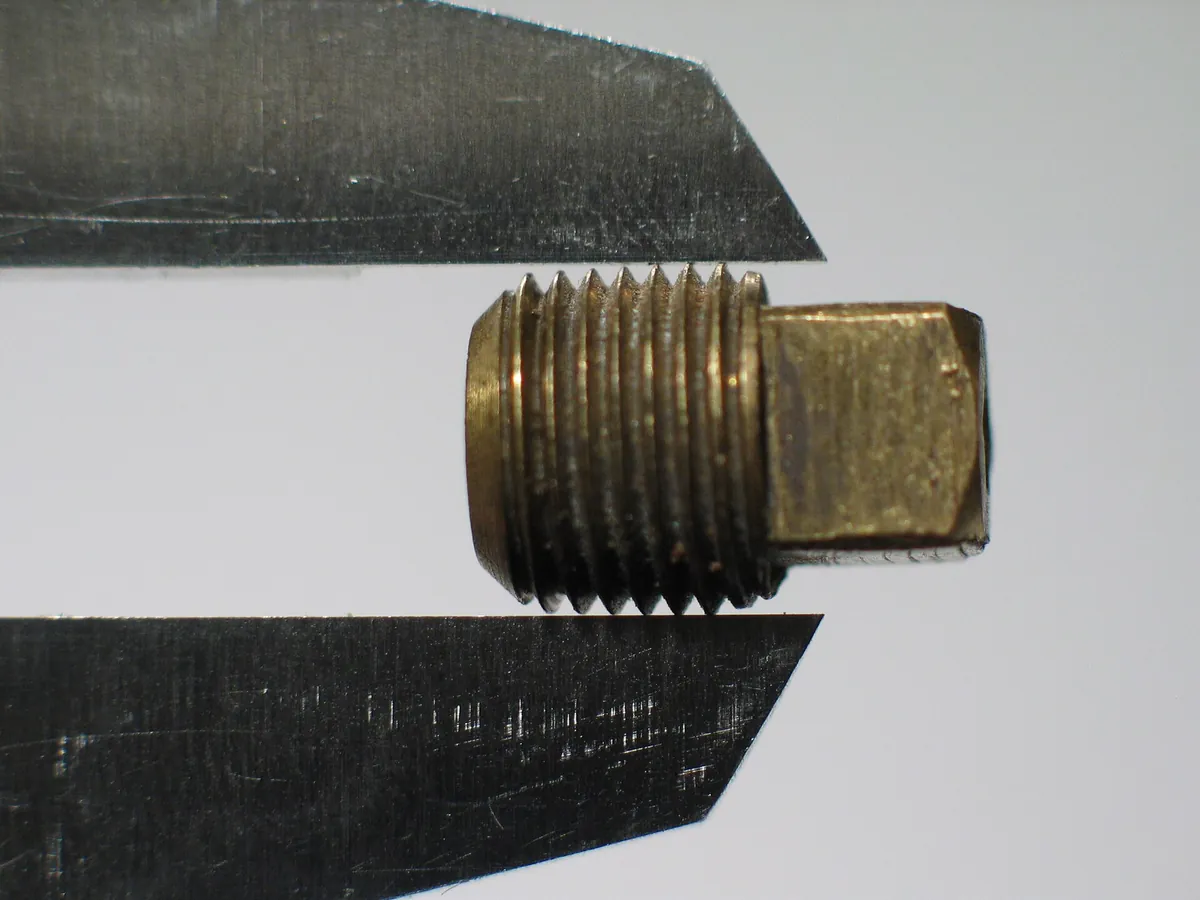
An NPT thread is cut on a cone. The diameter grows by 1 inch for every 16 inches of length, which is 3/4 in per foot. The thread form is a 60° V, the same angle as UNC and UNF bolts, but on a taper.

That taper is the whole idea. A male fitting starts easily because its small end enters the big end of the female thread. Every turn after that pushes a slightly larger male into a slightly smaller female, so the flanks of the thread press harder and harder against each other. A straight thread, by contrast, is the same diameter all along: it holds parts together, and the seal comes from a washer, gasket or O-ring.

The size is not the diameter
The number in front of "NPT" is a nominal pipe size, not a measurement. A 1/8 NPT thread is 0.405 in (10.29 mm) across, a 1/4 NPT is 0.540 in and a 1/2 NPT is 0.840 in. If you measure a fitting with calipers and look for that number on a bolt chart, you will land on the wrong thread. The table gives the outside diameter of the pipe (the male thread at its large end), the threads per inch and the drill for tapping each size without a taper reamer. More detail is on each size's page and in the NPT tap drill chart.

| Nominal | Pipe OD | TPI | Tap drill | Hand tight (L1) |
|---|---|---|---|---|
| 1/16 NPT | 0.313 in 7.94 mm | 27 | not listed | 4.32 turns 0.16 in |
| 1/8 NPT | 0.405 in 10.29 mm | 27 | R 0.3390 in | 4.36 turns 0.1615 in |
| 1/4 NPT | 0.540 in 13.72 mm | 18 | 7/16" 0.4375 in | 4.1 turns 0.2278 in |
| 3/8 NPT | 0.675 in 17.15 mm | 18 | 37/64" 0.5781 in | 4.32 turns 0.24 in |
| 1/2 NPT | 0.840 in 21.34 mm | 14 | 23/32" 0.7188 in | 4.48 turns 0.32 in |
| 3/4 NPT | 1.050 in 26.67 mm | 14 | 59/64" 0.9219 in | 4.75 turns 0.339 in |
| 1 NPT | 1.315 in 33.40 mm | 11-1/2 | 1-5/32" 1.1563 in | 4.6 turns 0.4 in |
| 1-1/4 NPT | 1.660 in 42.16 mm | 11-1/2 | 1-1/2" 1.5000 in | 4.83 turns 0.42 in |
| 1-1/2 NPT | 1.900 in 48.26 mm | 11-1/2 | 1-47/64" 1.7344 in | 4.83 turns 0.42 in |
| 2 NPT | 2.375 in 60.33 mm | 11-1/2 | 2-7/32" 2.2188 in | 5.01 turns 0.436 in |
Hand tight and wrench makeup
ASME B1.20.1 defines how far the parts go together by hand (L1, the hand-tight engagement) and allows about 3 more turns with a wrench (L3, the wrench makeup). For 1/8 NPT that is 0.1615 in, about 4.36 turns, plus 3 turns (0.1111 in) of wrench makeup.

These are design allowances. They exist so that gauges, taps and fittings from different makers fit together: they are not tightening instructions. How far a real fitting turns depends on the fitting, the materials, the sealant and how the hole was tapped. Follow the fitting maker's assembly instructions. What the numbers are good for is diagnosis: a fitting that runs in by hand far past L1 usually means a hole tapped too deep or a worn thread, and more tape will not give back the missing taper.
How NPT seals, and why it needs sealant
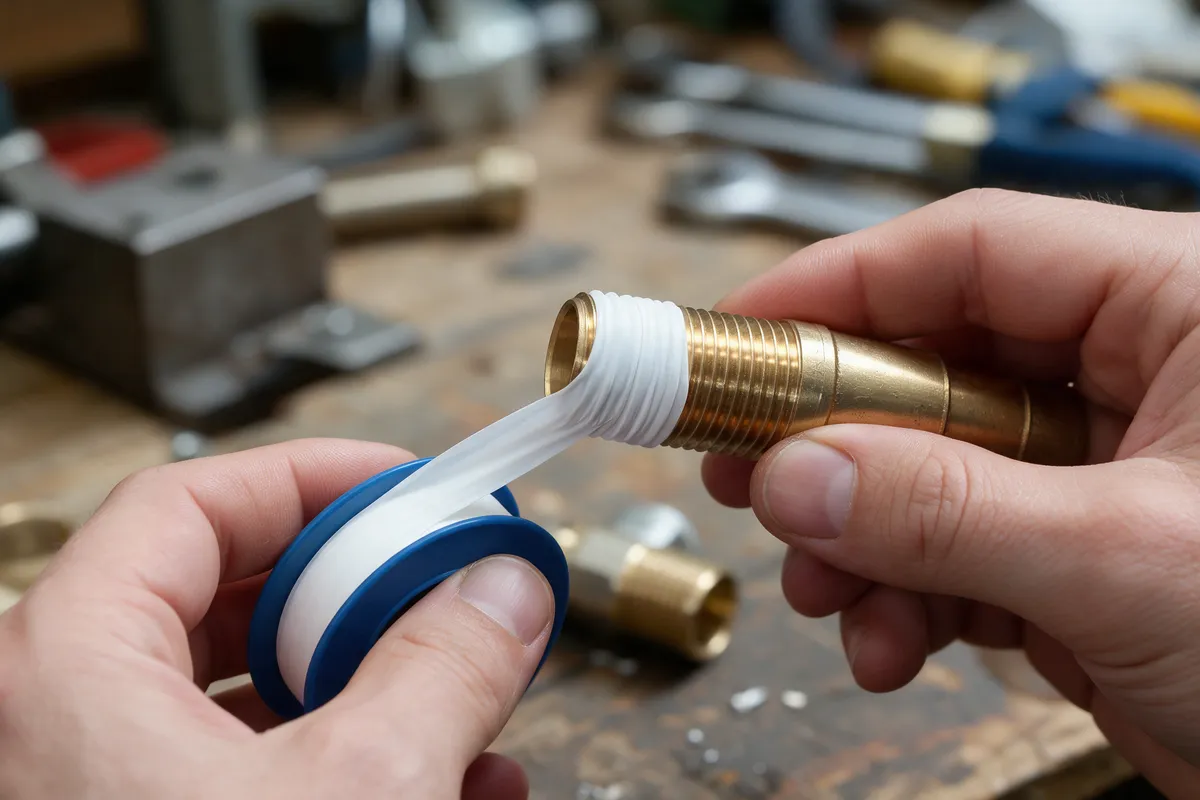
NPT seals on the flanks. The standard lets the crests and roots of the two threads clear each other slightly, which leaves a tiny spiral path running along the thread. PTFE tape or a pipe thread sealant fills that path and also lubricates the threads as they are tightened. That is why an NPT joint made up dry can weep even when it feels tight.
NPTF: the Dryseal version
NPTF (National Pipe Taper Fuel, also called Dryseal) is defined by a separate standard, ASME B1.20.3. It has the same basic profile, taper and threads per inch as NPT. The difference is in the crests and roots: their heights are held so the crests and roots of the male and female threads meet metal to metal. When the joint is tightened, that contact closes the spiral path, so two NPTF parts can make a pressure-tight joint without any sealant. The F stands for fuel, one of the services it was made for.
| NPT | NPTF (Dryseal) | |
|---|---|---|
| Standard | ASME B1.20.1 | ASME B1.20.3 |
| Taper, angle, TPI | 1 in 16, 60° | Same as NPT |
| Crests and roots | May leave a small gap | Made to meet, metal to metal |
| Seals with | PTFE tape or pipe sealant | The thread itself, when both parts are NPTF |
Because the profile is the same, NPT and NPTF parts thread into each other. The dry seal needs both halves to be NPTF, though. If one side is ordinary NPT, the joint has the NPT gap on that side, so a mixed joint is treated as an NPT joint and gets sealant. You cannot tell NPTF from NPT by eye; go by the marking or the part's documentation, and treat an unknown fitting as NPT.
Why is NPT still around?
It is a fair question when straight threads with O-rings seal more predictably and can be taken apart and reassembled. The answer is mostly practical. An NPT joint needs nothing but the two threaded parts and some sealant: no O-ring, gasket or machined sealing face. The same thread runs across pipe, valves, gauges and fittings throughout US plumbing, compressed air and industrial equipment, so every new part has to mate with what is already installed, and taps, dies and gauges for it are easy to find.
The costs are real too. The seal depends on sealant and on how the joint was made up, and each reassembly deforms the threads a little more. Where those costs matter, many systems use straight threads that seal on an O-ring or gasket instead. Both are in use because they suit different jobs.
Can a 1/8 NPT part go into a different thread?
It may start, which is the problem. Two common mix-ups:
- M10 x 1. Some sensor and fitting ports are tapped M10 x 1, a straight metric fine thread 0.394 in across with a 1 mm pitch. 1/8 NPT is 0.405 in at its large end with a pitch of 0.941 mm (27 TPI). The diameters are close enough for the first turn, but over the hand-tight length the pitches fall about 0.26 mm out of step, and the taper keeps growing on top of that. It binds, and forcing it damages the female thread.
- 1/8 BSPT. The British tapered pipe thread at the same nominal size has 28 threads per inch and a 55° thread angle, against 27 TPI and 60° for NPT, at a similar size and with the same 1 in 16 taper. It threads in a turn or two by hand and then jams or leaks, and tape may not seal a joint whose flanks do not match. The BSP thread chart lists the full set, and a BSP vs NPT comparison, by nominal size.
If a part has to go into a port with a different thread, use an adapter made for that pair of threads. To work out what a port actually is, see how to identify a thread.
Tapping an NPT hole yourself? Start from the NPT tap drill chart and the size pages, like 1/4 NPT, and read how to tap a hole first: with a tapered tap, depth decides the fit.