7/8-9 Tap Drill Size
Unified coarse (UNC) · 9 threads per inch · ASME B1.1, class 2B
What size drill bit for a 7/8-9 tap?
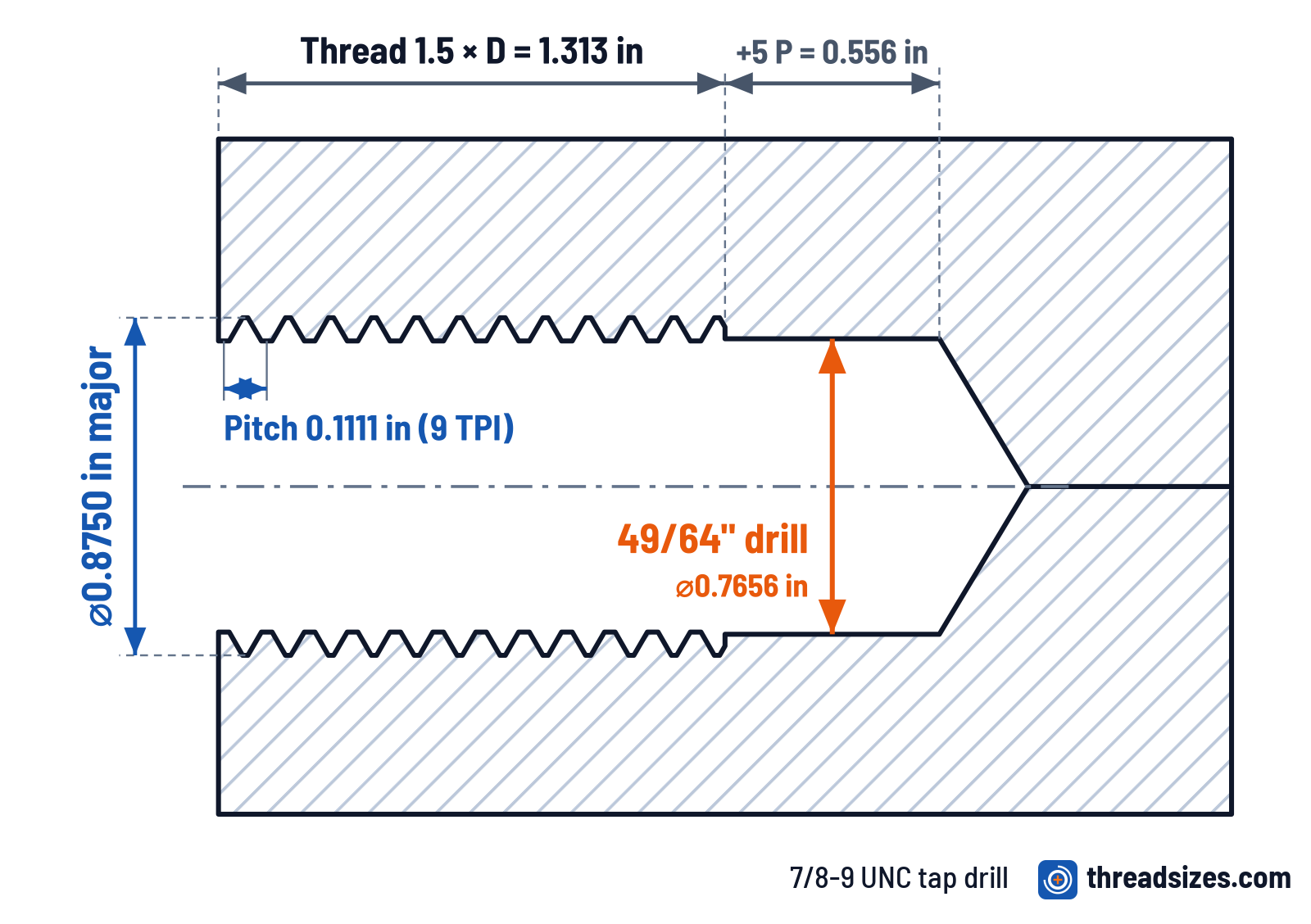
To scale section of the tapped hole
Drawing callout same hole, as a plan note
⌀.766 ↧1.87 / 7/8-9 UNC-2B ↧1.31
Thread depth 1.5 × D, drilled 5 pitches deeper for a plug tap; change both to suit your part. Through hole for a screw instead? Use the clearance hole: ⌀.938 normal fit (ASME B18.2.8, clearance hole chart). How to read this →
Drill options % of thread
| Drill | Inch | mm | Thread | 2B |
|---|---|---|---|---|
| 3/4" | 0.7500 | 19.05 | ✗ | |
| 49/64"Use | 0.7656 | 19.45 | ✓ | |
| 19.5 mm | 0.7677 | 19.50 | ✓ | |
| 25/32" | 0.7813 | 19.84 | ✗ | |
| 20 mm | 0.7874 | 20.00 | ✗ |
75% (orange tick) is the usual target. Hard or gummy metals like stainless are often tapped at 60 to 65% to spare the tap; aluminum, brass and plastic take 75% or a little more. The last column checks the hole against the 2B minor diameter limits (0.755 in to 0.778 in).
7/8-9 UNC ASME B1.1, class 2B
| Major diameter | 0.8750 in / 22.23 mm |
|---|---|
| Threads per inch | 9 TPI (pitch 0.1111 in) |
| Pitch diameter (basic) | 0.8028 in |
| Minor diameter 2B | 0.7547–0.7776 in |
| Thread depth (basic, 5/8 H) | 0.0601 in |
| Forming tap drill (estimate) | 55% 53/64" 0.8334 in65% 53/64" 0.8259 in75% 13/16" 0.8183 in |
Forming tap drills are estimates from the rule tap makers use (D − 0.0068 × % × pitch, in inches), shown at 55, 65 and 75% thread with the nearest drill; 65% is the usual starting point. Confirm with your tap maker's chart. Forming taps push the metal instead of cutting it, so never use this drill with a cutting tap.
Clearance hole ASME B18.2.8
For a screw that passes through the part. Normal fit is the default; close fit locates the part more accurately but allows less error in hole position. All sizes: clearance hole chart.
Wrench and key ASME B18.2.1, B18.2.2, B18.3
Wrench across the flats of a standard hex bolt head and hex nut, and the Allen key for a socket head cap screw. All sizes in the bolt size chart.
Cross-checks published tables that agree
| Tap drill 49/64" | 7 of 7 |
|---|---|
| Clearance holes | 2 of 3 |
| Hex head 1-5/16 in | 2 of 2 |
| Hex nut 1-5/16 in | 2 of 2 |
| Allen key 3/4 in | 2 of 2 |
Tables that list the same value, out of those that list one; a reprint of another table counts once. How values are checked.
Hole depth rule of thumb
- 0.875 inthread engagement to start from in steel (1 × D); the right figure depends on the materials, the thread class and the load
- 1.313 inin cast iron or brass (1.5 × D), up to 1.750 in in aluminum
- +0.556 inextra drill depth below the thread for a plug tap (5 pitches), +0.222 in with a bottoming tap
Full table and the ASME B1.1 formula: thread engagement chart.
Shop notes
49/64 (0.7656 in) is the standard 7/8-9 tap drill, about 76% thread and inside the 2B limits. In metric, 19.5 mm (74%) is the match. At this size both are drill press or lathe work, and so is the tapping: a 7/8 tap needs a long wrench and steady, square pressure.
The two fractions either side are both wrong. 3/4 in is under the minimum minor diameter (about 87%), and 25/32 is over the maximum (about 65%). If the 49/64 is missing, the 19.5 mm is the only nearby drill that stays inside the limits.
The fine version, 7/8-14, uses a 13/16 drill. The nearest metric size is M22, a little smaller (22 mm against 22.23 mm) and with a 2.5 mm pitch against 2.82 mm.
Tapped 7/8-9?