Taper, plug and bottoming taps
Updated October 11, 2026
Taps of the same size come with different ends. A taper tap, a plug tap and a bottoming tap cut the same thread; what changes is how many threads at the tip are ground down, the chamfer. That chamfer decides how easily the tap starts and how close to the bottom of a hole it can cut a full thread. Flute shape is a second, separate choice: it decides where the chips go.
The three chamfers
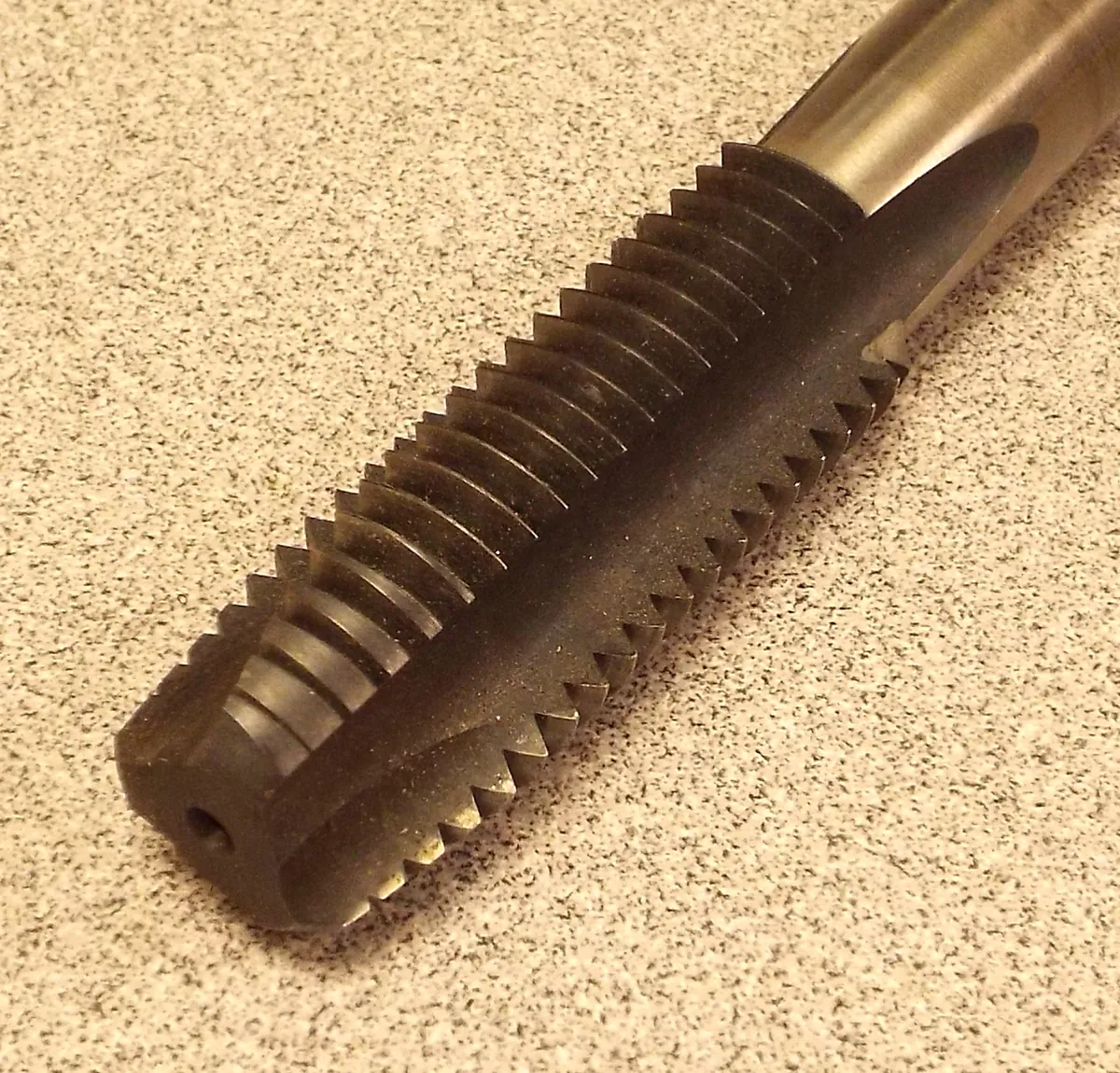
The chamfered threads do the cutting, a little deeper each one, until the first full thread finishes the profile. A long chamfer spreads the cut over more teeth, so the tap turns more easily and lines itself up better. A short chamfer puts all the work on one or two teeth, but leaves fewer partial threads at the bottom of the hole.
- Taper tap: 7 to 10 chamfered threads. Easiest to start square and the lightest to turn, which makes it the tap for starting a thread. In a blind hole it leaves several incomplete threads at the bottom.
- Plug tap: 3 to 5 chamfered threads (one tool seller lists 4 to 6). The general-purpose tap and the one you usually get when you buy a single tap. Fine for through holes and for blind holes drilled deeper than the thread.
- Bottoming tap: 1 to 2 chamfered threads. Cuts full thread nearly to the bottom of a blind hole, but is hard to start straight and needs more force. Use it to finish a hole another tap started.
The counts come from tap sellers' published specifications and vary a little between makers. In length, it is the count times the pitch:
| Thread | Pitch | Taper (7 to 10) | Plug (3 to 5) | Bottoming (1 to 2) |
|---|---|---|---|---|
| #10-24 | 0.042 in | 0.292 to 0.417 in | 0.125 to 0.208 in | 0.042 to 0.083 in |
| 1/4-20 | 0.050 in | 0.350 to 0.500 in | 0.150 to 0.250 in | 0.050 to 0.100 in |
| 1/2-13 | 0.077 in | 0.538 to 0.769 in | 0.231 to 0.385 in | 0.077 to 0.154 in |
| M6 x 1 | 1 mm | 7 to 10 mm | 3 to 5 mm | 1 to 2 mm |
| M10 x 1.5 | 1.5 mm | 10.5 to 15 mm | 4.5 to 7.5 mm | 1.5 to 3 mm |
Which one for which hole
Through hole: a plug tap does the whole job, and a taper tap works too and turns more easily. Neither needs a bottoming tap, because the chamfer just runs out the far side.
Blind hole, with room below the thread: a plug tap alone. This is why our thread pages say to drill 5 pitches deeper than the thread for a plug tap, a rule of thumb: the plug's chamfered threads, plus some space for chips, sit below the last full thread. For a 1/4-20 that is 0.250 in.
Blind hole, thread needed close to the bottom: start with a plug (or taper) tap, clear the chips, then finish with a bottoming tap. The thread pages give 2 pitches below the thread for that case (0.100 in for a 1/4-20). A three-tap set of taper, plug and bottoming exists for this sequence. A taper tap on its own is a poor choice here: 7 to 10 partial threads at the bottom is a lot of thread lost.
The step by step version, including how to start the tap and break the chips, is in how to tap a hole by hand.
Where the chips go: flute types
| Tap | Chips | Best for |
|---|---|---|
| Straight flute (hand tap) | Stay in the flutes; you back off to break them and clear them | General hand tapping; brittle metals like cast iron, where chips come off as powder |
| Spiral point (gun tap) | Pushed ahead of the tap, out the far side | Through holes |
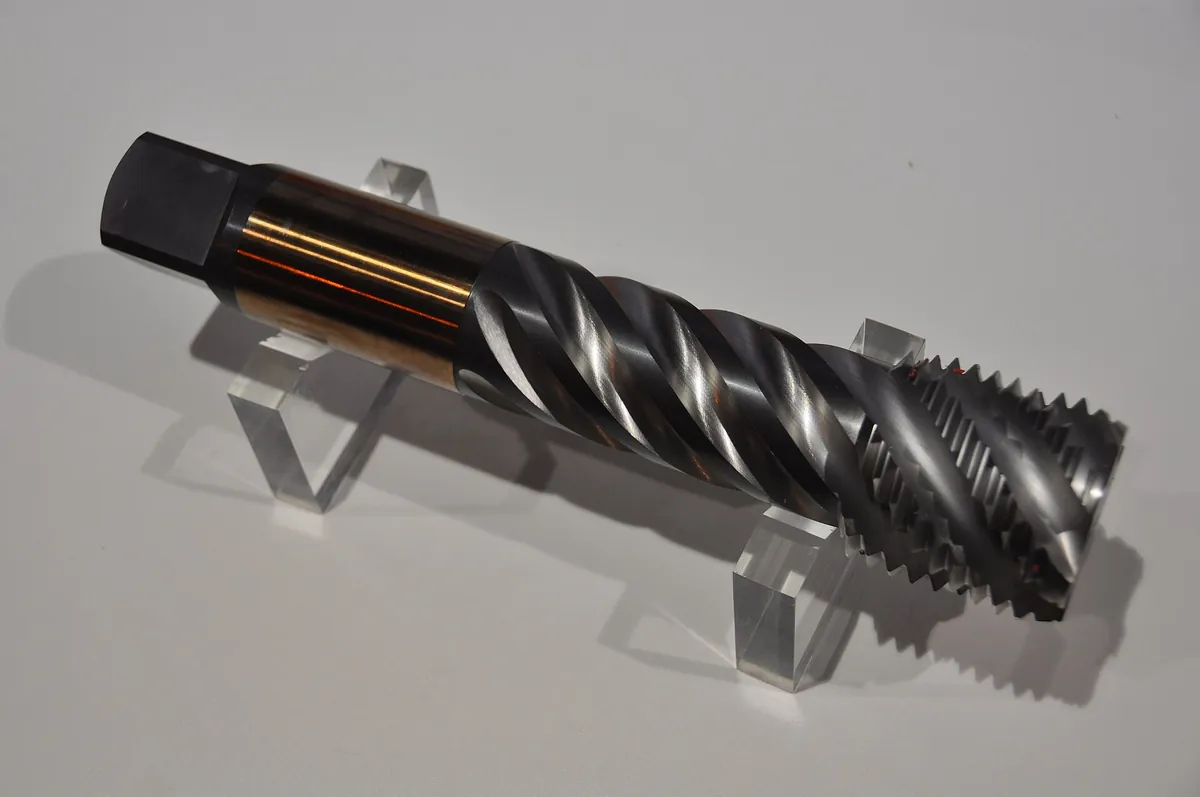
| Spiral flute | Pulled back up the flutes and out of the hole | Blind holes |
| Thread forming | None: the metal is pushed into shape | Ductile metals, through and blind holes |

A spiral point tap in a blind hole packs the chips into the bottom, where they can jam the tap. A spiral flute tap lifts them out, which is why it is the one sold for blind holes. By hand, both need less backing off than a straight flute tap, though it is still worth backing out if the tap starts to feel tight.

Thread-forming taps
A forming tap (also called a roll tap) has no cutting edges. It presses the thread into the wall of the hole, so it makes no chips. It needs a ductile material, one that flows rather than breaks, so it suits soft and ductile metals and not brittle ones like cast iron.
Because the metal is pushed inward to form the crests, a forming tap needs a bigger hole than a cutting tap. For a 1/4-20, the cutting tap drill is a #7 (0.2010 in), while the forming tap estimate at 65% thread is 0.2279 in, nearest drill #1. Each thread page shows forming drill estimates at 55, 65 and 75% thread, worked out with the formula tap makers publish; check the maker's chart for your tap. Never use the forming drill with a cutting tap, or the cutting drill with a forming tap: one gives a shallow thread, the other can break the tap.
Reading the shop drawer
If a tap has no label, look at the tip. Count the ground-down threads: many means taper, a few means plug, one or two means bottoming. A tap with flutes that wind up the body is a spiral flute; one with a short angled cut at the front of the flutes is a spiral point; a tap with no flutes, usually with small grooves along the body, is a forming tap. To find the size and pitch, see how to identify a thread and the tap drill chart.